Kenya, Uganda, Rwanda, and Tanzania sit close enough on a map that combining all four feels obvious. The logistics are less simple. Two visa systems, four currencies, and at least three land borders need to line up. Add two very different primate-and-migration itineraries on top. Touring Insights breaks down what a real four-country route costs and how the borders and flights actually connect. It also covers how much time you genuinely need to do it without rushing.
Why Combine Four Countries in One Safari
Each country brings something the others do not. Kenya’s Masai Mara and Tanzania’s Serengeti share the same wildebeest migration, just on different sides of a border. Uganda and Rwanda hold the region’s mountain gorillas, an experience neither Kenya nor Tanzania can offer. A traveler chasing both a Big Five safari and a gorilla trek used to face two separate trips. Better flight connections and a joint visa for three of the four countries have made a single extended trip realistic. Combining the migration circuit with a gorilla trek still adds a long overland or flight leg. That extra leg lands on top of an already busy itinerary.
Visas: The East Africa Tourist Visa and Tanzania’s Separate Rules
Kenya, Uganda, and Rwanda share the East Africa Tourist Visa (EATV). It is a single USD 100 fee. That fee stays valid for 90 days from your first entry into any of the three countries. It allows multiple entries within that window. You can fly into Nairobi, cross into Uganda, and continue to Rwanda on one approval. Tanzania sits outside this scheme entirely. Most travelers need a separate Tanzania eVisa, an indicative USD 50 for a single entry. US passport holders typically pay USD 100 for a multiple-entry version.
| Detail | Kenya / Uganda / Rwanda | Tanzania |
|---|---|---|
| Visa type | East Africa Tourist Visa (joint) | Separate Tanzania eVisa |
| Fee (indicative) | USD 100 total for all three | USD 50 single entry (USD 100 multiple entry for US citizens) |
| Validity | 90 days from first entry | Varies by entry type, confirm at application |
| Entries allowed | Multiple, within the three-country zone | Per application terms |
| Apply through | Immigration portal of first-entry country | Tanzania Immigration eVisa portal |
Apply for both visas before you travel. Tanzania’s eVisa and the EATV run on separate systems, so approval for one does not cover the other.
Borders and Flights: How the Route Connects
A four-country trip moves through a mix of international airports and land borders. Nairobi’s Jomo Kenyatta International Airport (JKIA) is the most common entry point. A domestic or road leg then continues to the Masai Mara. From there, the route typically continues into Tanzania through the Namanga border post. That crossing sits roughly 80 km from the Amboseli gate area and about 110 km short of Arusha. An alternative is Isebania-Sirari further west, near the Mara-Serengeti border itself. Uganda and Rwanda connect through Entebbe International Airport (EBB) and Kigali International Airport (KGL). The Katuna/Gatuna land border links the two countries directly. Busia and Malaba are the main Kenya-Uganda road crossings.
| Leg | Route | Approx. Distance | Approx. Time |
|---|---|---|---|
| Nairobi (JKIA) to Masai Mara | Road or domestic flight | 270 km | 5-6 hr drive, or approx. 45 min flight |
| Amboseli to Namanga border | Road | 80 km | 1.5-2 hr |
| Namanga to Arusha | Road | 110 km | approx. 2 hr |
| Arusha to Serengeti | Road | 335 km | 6-7 hr drive |
| Entebbe to Bwindi (Uganda gorillas) | Road or domestic flight | 460-520 km | 8-9 hr drive, or 1-1.5 hr flight |
| Kigali to Volcanoes National Park (Rwanda gorillas) | Road | 110 km | 2-2.5 hr |
Border posts can run slower than airport immigration, especially around public holidays. Build in buffer time rather than scheduling a tight connection on a crossing day.
Masai Mara vs Serengeti: Choosing Your Migration Base
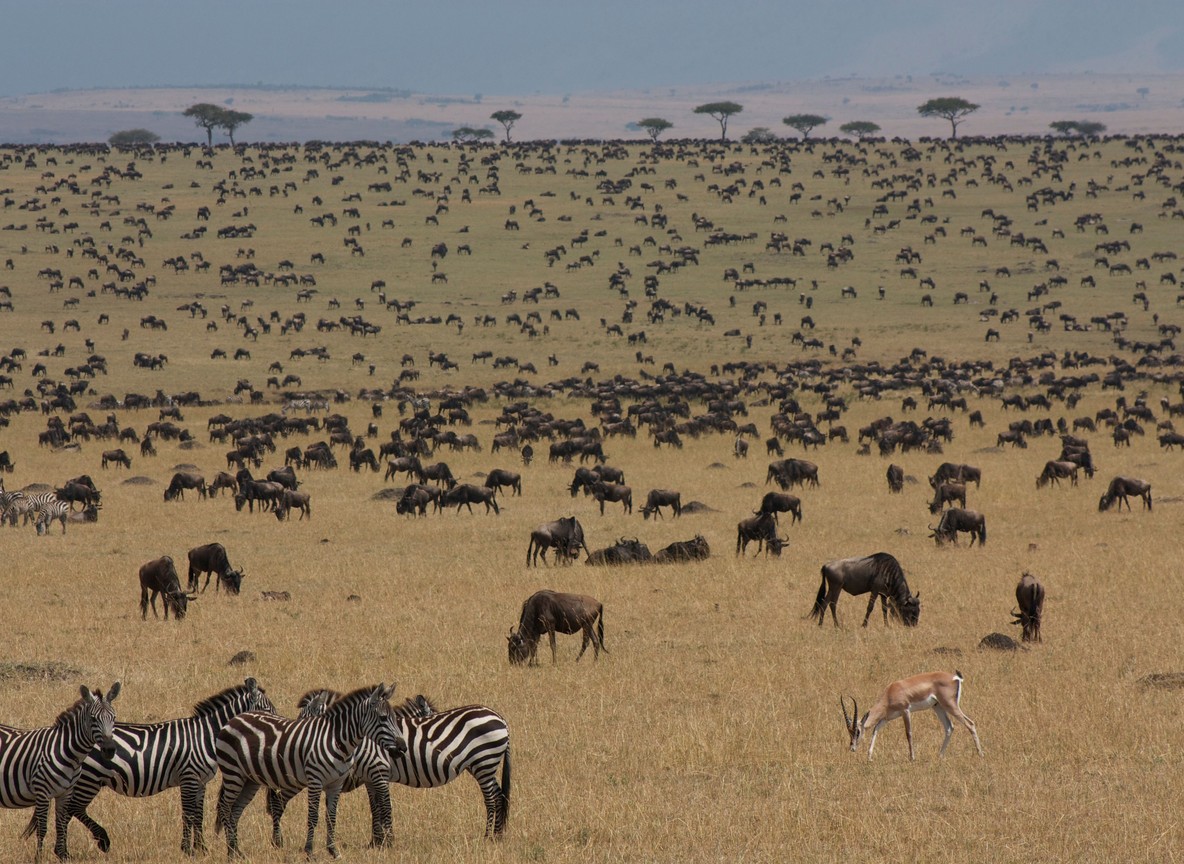
The same wildebeest herds cross between Kenya’s Masai Mara National Reserve and Tanzania’s Serengeti National Park each year. Still, the two parks differ enough in size, fees, and access to matter for planning. The Mara is smaller and sits closer to Nairobi. Serengeti, by contrast, is far larger and pairs naturally with Ngorongoro Crater and Tarangire on a northern Tanzania circuit.
| Detail | Masai Mara (Kenya) | Serengeti (Tanzania) |
|---|---|---|
| Park size | approx. 1,510 km2 (plus Mara Triangle, approx. 510 km2) | approx. 14,750 km2 |
| Gateway airport | Jomo Kenyatta International (Nairobi) | Kilimanjaro International (JRO), near Arusha |
| Non-resident entry fee (verified 2026) | USD 100/day Jan-Jun, USD 200/day Jul-Dec, ticket valid 12 hours | indicative USD 60-82/day, confirm current TANAPA rate |
| Key airstrips | Keekorok, Ol Kiombo, Musiara | Seronera, Kogatende |
| Best paired with | Amboseli, Nairobi city stopover | Ngorongoro Crater, Tarangire |
Masai Mara fees jump sharply from July through December, the peak migration months. A July trip therefore costs more in park fees alone than a February one. Confirm the current gate rate with your operator, since both countries adjust fees without much notice.
Adding Gorilla Trekking: Rwanda or Uganda
A gorilla trek is usually the deciding factor. It is what turns a two-country Kenya-Tanzania safari into a genuine four-country route. Rwanda’s Volcanoes National Park sits closest to a capital city airport of any gorilla destination in the region. It is a two to two-and-a-half-hour drive from Kigali. Uganda’s Bwindi Impenetrable National Park costs less per permit but demands more travel time from Entebbe.
| Detail | Rwanda (Volcanoes NP) | Uganda (Bwindi/Mgahinga) |
|---|---|---|
| Standard gorilla permit (non-resident) | USD 1,500 | USD 800 |
| Nearest airport | Kigali International (KGL) | Entebbe International (EBB) |
| Airport to park | approx. 110 km, 2-2.5 hr | approx. 460-520 km, 8-9 hr drive, or 1-1.5 hr flight |
| Habituated gorilla families | 12 | approx. 20 across both parks |
Rwanda suits travelers with less time who can absorb the higher permit fee. Uganda suits travelers building a longer trip who want the lower fee and do not mind an extra travel day. Either country connects to the rest of a four-country itinerary through the shared East Africa Tourist Visa. The visa cost stays the same whichever gorilla park you pick.
Ngorongoro Crater and the Northern Tanzania Circuit
Most travelers routing through Tanzania add Ngorongoro Crater and Tarangire National Park alongside the Serengeti. All three sit on the same northern circuit out of Arusha. The Ngorongoro Conservation Area covers roughly 8,292 km2. Its crater rim sits at about 2,286 meters elevation. The crater floor itself is a compact 260 km2, roughly 600 meters below that at around 1,700 meters. Conservation fees run an indicative USD 70-80 per person per day. A separate crater descent fee adds an indicative USD 250-300 per vehicle. Tarangire, known for its baobabs and dense elephant herds, spans roughly 2,850 km2 about 118 km from Arusha. One full day on the crater floor covers most of what the site offers.
Budgeting and Trip Length for a Four-Country Route
A genuine four-country trip covering Kenya, Uganda, Rwanda, and Tanzania rarely fits into less than 18-21 days. That accounts for border transfers, internal flights, and enough nights at each stop to make the travel worthwhile. Shorter trips usually drop one country, most often Uganda or Rwanda, rather than rush all four.
| Cost category | Indicative range (per person) |
|---|---|
| EATV (Kenya, Uganda, Rwanda) | USD 100 |
| Tanzania eVisa | USD 50-100 |
| Gorilla permit (one trek, Rwanda or Uganda) | USD 800-1,500 |
| Masai Mara park fees (per day) | USD 100-200 |
| Serengeti park fees (per day, indicative) | USD 60-82 |
| Ngorongoro conservation fee (per day, indicative) | USD 70-80, plus USD 250-300 crater descent per vehicle |
These figures cover entry fees and permits only, not flights, accommodation, or guiding. Those categories usually make up the larger share of the total trip cost. Ask your operator for a full quote once your route and lodge tier are set.
Explorer Notes
Order matters more than most first-time planners expect. Doing the gorilla trek early in the trip, before the migration safari, protects the schedule. A bad-weather trekking day then does not threaten the rest of a tightly booked itinerary. Pack for both extremes. Bring warm layers for high-altitude gorilla trekking, and lighter breathable clothing for the hot, dusty Mara and Serengeti plains. Confirm your passport has at least six months validity beyond your return date. It also needs enough blank pages for four countries’ stamps. Yellow fever vaccination certificates are commonly requested across all four countries. Carry a physical copy alongside your passport, not just a photo on your phone.
What to Read Next
- Weighing a gorilla trek against a Kenya-only trip? See our gorilla trekking vs pure Kenya safari guide.
- Still deciding between the two migration parks? Read our Masai Mara vs Serengeti comparison.
- Crossing between the Mara and the Serengeti yourself? Check our Masai Mara and Serengeti cross-border safari guide.
FAQ
How many days do I need for a Kenya, Uganda, Rwanda, and Tanzania safari? Most realistic itineraries run 18-21 days. That allows enough nights at each stop, plus buffer time for border crossings and internal flights. None of the four countries gets cut down to a rushed one-night stop.
Does one visa cover all four countries? No. The East Africa Tourist Visa covers Kenya, Uganda, and Rwanda for one USD 100 fee. Tanzania needs a separate eVisa, typically USD 50 for a single entry.
Should I do the gorilla trek in Rwanda or Uganda if I am also visiting Kenya and Tanzania? Rwanda’s Volcanoes National Park sits closer to its capital airport and costs more per permit. Uganda’s Bwindi costs less but takes longer to reach. Either pairs fine with a Kenya-Tanzania migration safari through the shared visa zone.
Can I see the wildebeest migration in both the Masai Mara and the Serengeti on one trip? Yes, if your timing lines up with the herds’ seasonal position. You also need to build in the Namanga or Isebania border crossing between the two. Confirm current migration location with your operator before finalizing the route.
Do park and conservation fees change often? Yes. Masai Mara, Serengeti, and Ngorongoro fees have all moved in recent years, and Kenya’s rates in particular jumped in 2025. Always confirm the current rate with your camp or operator rather than relying on last year’s figure.
A four-country trip has more moving parts than any single-country safari. The payoff is seeing the full range of what East Africa offers in one journey. Check the Tour Packages page for itineraries already built around this route. Or ask a partner operator to help sequence the border crossings and permit bookings around your travel dates.
Further reading
More safari planning resources
- Maasai Mara interactive map from SafariPure
- Wildebeest migration route map from Valley Safaris
- Kenya eTA and eVisa guide on Touring Insights
- Great Migration safari collection on FindMySafari
Related guides: African Safari Animals: An East Africa Wildlife Guide, The Ultimate Guide to Private Safari Experiences in East Africa.